The Sydney Peace Foundation’s Gold Medal for Human Rights is a prestigious acknowledgement of an individual’s exceptional contribution to human rights and social and environmental justice. Gold Medal recipients are recognised for their moral courage in advancing meaningful and tangible change, often at significant personal or professional risk. The award recognises individuals whose work reflects a sustained and genuine commitment to advancing peace with justice, and whose leadership inspires broader movements and conversations. The Gold Medal is presented only occasionally, and the decision to bestow the award is made by the Sydney Peace Foundation Board.


Gold Medal for Human Rights
2026 – Dr Bob Brown
Gold Medal for Human Rights
On 24 July 2026, Australian environmental leader Dr Bob Brown was awarded the Gold Medal for Human Rights for “his life-long commitment to environmental and social justice, courageously standing up for nature and a sustainable world. Impactful environmental campaigns, spearheaded by his visionary leadership, and the creation of the Bob Brown Foundation, are a life-affirming legacy for this fragile planet and society.”
Melanie Morrison, Director of the Sydney Peace Foundation, said:
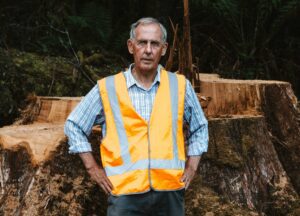
For over half a century, Bob Brown has stood as a fearless defender of our planet, staring down powerful lobby groups and corporate power. He is one of the most courageous environmental and human rights champions of our time, who continues to inspire climate activists to defy destructive systems and fight for our natural world.
To watch or read Bob Brown’s keynote address, click here.
2023 – Aung Myo Min
Gold Medal for Human Rights
On 2 June 2023, the Sydney Peace Foundation awarded its Gold Medal for Human Rights to Aung Myo Min.
The citation reads, “for inspiring a generation of pro-democracy advocates in Myanmar. His lifelong work is an example of how hope, courage, and the values of justice can grow out of the most difficult circumstances.”
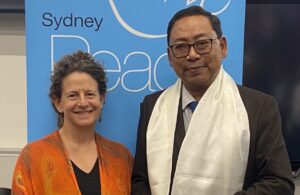
Aung Myo Min is the Union Minister for Human Rights in the cabinet of the National Unity Government of Myanmar. Prior to joining the NUG, he was one of Myanmar’s most prominent human rights advocates and a youth leader in the 1988 democracy uprising. Aung Myo Min lived in exile for 23 years and continued working on human rights issues in Myanmar, particularly in relation to marginalised people. He graduated with a Masters’ Degree in human rights from Columbia University, New York, in 1993. He has received eight human rights awards for his outstanding human rights work, including the Schuman Human Rights Award in 2017.
Dr Susan Banki, Sydney Peace Foundation board member and Asia-Pacific expert in the University of Sydney’s School of Social and Political Sciences, said
“It’s a great honour to recognise Aung Myo Min with the Sydney Peace Foundation Gold Medal for Human Rights, for inspiring a generation of pro-democracy advocates in Myanmar. Aung Myo Min’s lifelong work, most often practiced under deeply restrictive conditions, is an example of how hope, courage, and the values of justice can grow out of the most difficult circumstances.”
To learn more, click here.
2020 – Midnight Oil
Gold Medal for Human Rights
On 26 November 2020, the Sydney Peace Foundation awarded its Gold Medal for Human Rights to Midnight Oil. The citation reads, ‘For shining a light on the climate crisis, promoting solutions and fearlessly denouncing those destroying the planet, for their leadership in the political awakening of a generation of climate action leaders and through their songs of defiance and strength providing hope that together we can build a peaceful and just world’.
Former Chair of the Sydney Peace Foundation, Archie Law, said,
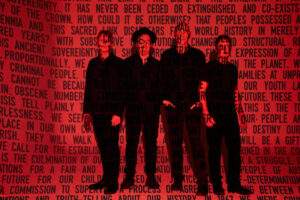
Midnight Oil is and has for decades been an Australian human rights trailblazer. This Medal is in recognition of that relentless focus,
and in particular for their environmental activism, their humanity and their drive to promote
justice through both their music and their actions.
To learn more, click here.
2020 – Christiana Figueres
Gold Medal for Human Rights
On 12 March 2020, the Sydney Peace Foundation awarded its Gold Medal for Human Rights to Christiana Figueres. The citation reads, ‘For extraordinary leadership to address the climate crisis and reminding us that outrage and optimism are equally important to change the world.’
During her tenure as Executive Secretary of the United Nations Framework Convention on Climate Change from 2010-2016, she brought together governments, corporations and activists, financial institutions and NGOs to jointly deliver the historic Paris Agreement on climate change.
Former Director of the Sydney Peace Foundation, Susan Biggs, said,
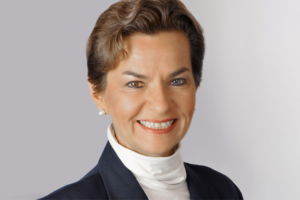
Figueres is one of the world’s top negotiators. Having done what many said was impossible, she brought the world to the table to sign the Paris Agreement. She is now challenging governments, business and civil society to work together to stop the climate from rising to catastrophic levels. Figueres’ powerful leadership reminds us to balance outrage and optimism because we must maintain the anger so we act quickly, and also the hope that change is possible.
To learn more, click here.
2013 – Stéphane Hessel
Gold Medal for Human Rights
In 2013 the Sydney Peace Foundation awarded a posthumous Gold Medal for Human Rights to Stéphane Hessel, former French resistance fighter, concentration camp survivor, co-author of the Universal Declaration of Human Rights and author of the ground breaking book, Time for Outrage.
On May 2nd, at the Australian Ambassador’s Residence in Paris, Ambassador Ric Wells presented the award to Christiane Hessel-Chabry, Hessel’s widow.
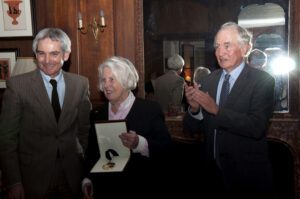
Chair of the Sydney Peace Foundation, Professor Stuart Rees, described Hessel as ‘a towering figure of 20th century resistance.’ Hessel insisted on respect for the universality of human rights and he inspired the Occupy Movement’s protest against what he called ‘the international dictatorship of the financial markets.’
To learn more and see pictures, click here.
2011 – Julian Assange
Gold Medal for Human Rights
The Sydney Peace Foundation awarded the Gold Medal to WikiLeaks co-founder Julian Assange in 2011. The citation reads, ‘For exceptional courage and initiative in pursuit of human rights’.
In accepting the Gold Medal, Mr Assange said that “the real value of this award, and the Sydney Peace Foundation, is that it makes explicit the link between peace and justice.”
The Founder of the Sydney Peace Foundation, Emeritus Professor Stuart Rees, said,
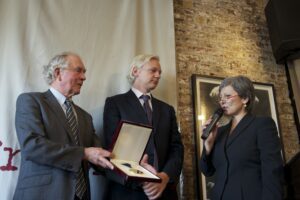
‘Assange’s work is in the Tom Paine Rights of Man and Daniel Ellsberg Pentagon Papers tradition- challenging the old order of power in politics and in journalism. Assange has championed people’s right to know and has challenged the centuries old tradition that governments are entitled to keep the public in a state of ignorance. In the Paine, Ellsberg and Assange cases, those in power moved quickly to silence their critics even by perverting the course of justice’.
For more on Julian Assange’s award, including a video of the ceremony at London’s Frontline Club, click here.
2009 – Daisaku Ikeda
Gold Medal for Human Rights
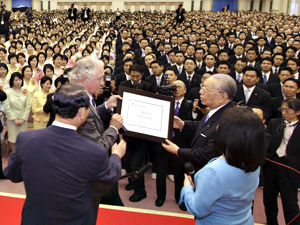
Sydney Peace Foundation Executive Committe member Marie Whybourne travelled to Japan in 2009 to present the Gold Medal for Human Rights to Daisaku Ikeda, the Japanese Buddhist philosopher, educator, writer and peace activist (seen here with Founder Professor Emeritus Stuart Rees).
Dr Ikeda founded Soka Gakkai International, an organisation with ten million members world wide who share a philosophy which emphasises the value and dignity of all life and the responsibility of every individual to contribute to building a world where people of diverse cultures and faiths can live in peace.
2002 – THE DALAI LAMA
Gold Medal for Human Rights
His Holiness the Dalai Lama was awarded the Sydney Peace Foundation Gold Medal in recognition of his untiring work for human rights, non-violence and world peace.
To learn more about the event or watch a recording, click here.
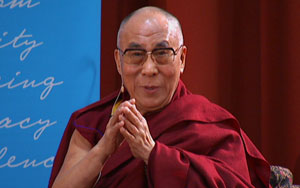
“Look at basic human nature. Our mothers give birth to us and we survive because of the affection she shows us. If she abandons us, we die. Because of the affection we receive as infants, we have the potential to show affection to others. However, as we grow up we tend to feel we can look after ourselves and have no need for others’ support and affection. And yet we are social animals, whose very existence and opportunity to live a happy life depends on the rest of our community. In our modern education system, we need to find a way to nurture our basic human values.”
2000 – Nelson Mandela
Special Recognition
Former President of South Africa, Nelson Mandela, visited the Sydney Peace Foundation in 2000. The Sydney Peace Foundation gave Mandela special recognition at an informal engagement at the Centre for Peace and Conflict Studies, University of Sydney.
During his time with the Foundation on 4th September, he drew upon a life-time’s experience dedicated to the attainment of peace with justice in an impromptu discussion on reconciliation.
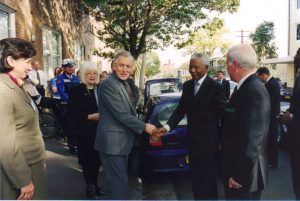
“Reconciliation,” Mandela said, means to “ensure that we eliminate tension in society” in order to “create an environment where people appreciate the gifts and talents of each other.”
He said there is a need to “forget the past – we are not very responsible for the past, but we are responsible for the present and the future.”
This acknowledgement predicated the process of establishing a more formal award.
To read about Mandela’s visit, click here.
2000 – Dr Stella Cornelius and Dr Faith Bandler
Certificate
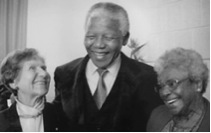
During his time in Sydney, Mandela also presented Dr Stella Cornelius, founder of the Conflict Resolution Network, and Dr Faith Bandler, campaigner for indigenous rights in Australia, with certificates for their dedication and achievements in conflict resolution and education.